PROVISIONAL MILITARY FLAG OF FLORIDA
Florida did not have a state flag at the time state forces seized the federal Pensacola Navy Yard on January 12, 1861, just two days after the state voted to secede from the Union. After the United States flag was hauled down, it was reported that initially “a dingy white flag” that “looked like an old signal flag with a star put on it” was hoisted the next day in its place. Colonel William H. Chase, commanding Florida state forces at Pensacola, issued orders one day later establishing a provisional military flag. It was to be used until such time as civil authorities designed a state flag.
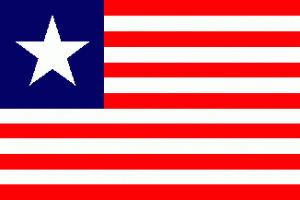
Provisional military flag of Florida adopted 13 January 1861
by Devereaux D. Cannon, Jr., 05 February 2000
Colonel Chase chose a pattern that simply altered the United States flag. Chase’s General Order No. 3 of January 13, described a flag of thirteen alternating red and white stripes, with one large white star on a blue field (canton). The order further stated that it was to be displayed at the Navy Yard, forts, barracks, and hospital in possession of Florida state troops.
It seems likely that these provisional Florida flags may have been made from existing stocks of captured United States flags from the Navy Yard. U.S. flags could have been easily altered by stripping the stars and replacing them with a single large one. The large star apparently represented the recently seceded sovereign state of Florida. On January 14, the first of these flags was raised. A Union ship in Pensacola harbor recorded in its logbook: “Florida forces hoisted the American flag with lone star.” Another reference to this flag occurred on February 22, when southern and northern forces around Pensacola commemorated George Washington’s birthday with cannon salutes. Observers on the same Union ship reported that the “flag of one star and many stripes” was visible flying over Fort Barrancas. This lone star pattern was not unique. The Texas navy also used this pattern from 1836 to 1845.
Although no official order discontinuing use of this flag is known, events in March 1861 appear to have led to its demise. Control of the Navy Yard and surrounding forts was transferred from state to Confederate national authority. Colonel Chase resigned and Brigadier General Braxton Bragg was later appointed area commander. On March 4 the recently formed Confederacy adopted its new national flag, which apparently soon replaced Florida’s provisional flag. Units from other southern states, including Alabama, Mississippi, Georgia, were also gathered in the Pensacola area, so the need existed for a unifying symbol. The close similarity in appearance between Florida’s provisional flag and that of the United States made the flag impractical during wartime. No examples of these provisional Florida flags are known to have survived. It is quite possible that they were recycled, with the material being used to construct Confederate first national flags.
No references have been found that indicate that this flag saw use by Florida forces outside of the Pensacola area. Likewise, no documentation is known that this flag pattern was used as a unit flag by Floridians.
FLORIDA STATE FLAG, 1861 PATTERN
As the question of possible secession arose in late 1860, the state legislature considered adopting a state flag and state uniform. No decision was made before adjourning at the end of the year. The issue came up again in early 1861, with legislative agreement that a state flag was needed. On February 8, a law was enacted authorizing and directing the governor, “with the advice and consent of his staff,” to “adopt an appropriate device for a State flag which shall be distinctive in character.”
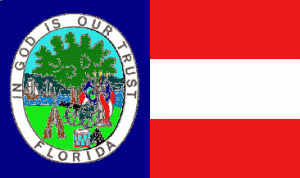
Florida state flag adopted 13 September 1861
by Devereaux D. Cannon, Jr., 05 February 2000
Since more than six months elapsed before a design was chosen, Governor Madison Stark Perry must have had more pressing war-related priorities. On September 13, 1861, Governor Perry reported that “the Flag has been deposited in the Executive Chamber.” The secretary of state then recorded a detailed description of Florida’s state flag.
The Confederate first national flag greatly influenced the design chosen by the governor of Florida. In fact, the Florida state flag can be viewed as a modification of the national pattern. The flag kept the red, white, and red bars, expanded the blue canton to form the left half of the state flag and replaced the stars with a unique seal representing Florida. The new seal was in the shape of a vertical oval, called an ellipse. The edge of the ellipse or oval band formed a frame bearing the inscriptions of the early statehood period motto above: “In God Is Our Trust” and the state name below: “Florida.” The seal itself was complex as the description notes: “In the center of the ellipse is a single strong Live Oak Tree. Beyond is seen the Gulf of Mexico, with vessels in the distance. In front of and near the foot of the Oak is a piece of Field Artillery. Beyond the gun, and resting against the boll of the Oak, is seen a stand of six colors-the Confederate and State Flags to the front. To the left of the Field Piece are Four Muskets stacked. To the right and near, balls piled and a drum.”
The timing of the introduction of the flag, in the closing weeks of Governor Perry’s administration, is interesting. It would appear that the flag was produced mainly to comply with the legislative directive. There are no indications that the incoming governor, John Milton, made any attempts to promote his predecessor’s state flag design, or to produce and distribute multiple flags. The lack of a state flag tradition, combined with the difficulty of reproducing a rather complex seal design, were no doubt factors working against the production of more flags. Additionally, the delay in choosing a design, along with the rise of southern nationalism and the popularity of the Confederate first national flag, further undercut the demand for a state flag. No further period references have been found to this state flag or to its use. There is a distinct possibility that no additional state flags were produced, beyond the one official example. This flag is not known to have survived and the illustration is based on the written description.
Bruce Graetz