Failed Contestants for the First Confederate Flag
(February-March 1861)
by Devereaux D. Cannon, Jr. 25 February 2000
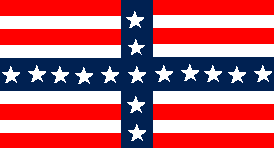
This proposal by Robert C. Gilchrist
of Charleston, of South Carolina was
sent by express courier to Christopher
G. Memminger on 4 February 1861,
the day the Montgomery Convention
which created the Confederate States
was opened. Retaining the idea of
the Stars & Stripes, Gilchrist
removed the canton and placed the
stars on a blue cross which spread
across the red and white stripes.
This early design by the prominent citizen, who had been Commissioner of the United States District Court and the US Court of Claims for the District of South Carolina, received wide publicity. However, in a letter to the South Carolina delegation dated 7 February 1861, signed by Charles H. Moise, the Jewish congregations of South Carolina objected to the adoption of a sectarian symbol as the flag of the new country.
Devereaux D. Cannon, Jr.

by Devereaux D. Cannon, Jr. 12 July 1998
This design was proposed by an
unnamed gentleman of Louisville,
Kentucky. He reversed the colours
of the US flag, having blue and
white stripes, with the white
stars on a red union. He wrote that
the seven blue stripes represented
“the Seven Seceding States, taking
the lead. His drawing shows 15 stars
in the red canton, but his letter
indicated that the number of stars
was to equal the number of States in
the Confederacy.
Devereaux D. Cannon, Jr.
![[Confederate Flag Proposal]](http://www.crwflags.com/fotw/images/u/us!cs3.gif)
by Devereaux D. Cannon, Jr. 12 July 1998
This design was proposed by an
unnamed gentleman of Louisville,
Kentucky. He reversed the colours
of the US flag, having blue and
white stripes, with the white
stars on a red union. He wrote that
the seven blue stripes represented
“the Seven Seceding States, taking
the lead. His drawing shows 15 stars
in the red canton, but his letter
indicated that the number of stars
was to equal the number of States in
the Confederacy.
Devereaux D. Cannon, Jr.
Here we see a number of variations on a theme submitted by P. J. Anderson of Montgomery, Alabama.
Devereaux D. Cannon, Jr.

by Devereaux D. Cannon, Jr. 12 July 1998

by Devereaux D. Cannon, Jr. 12 July 1998

by Devereaux D. Cannon, Jr. 12 July 1998

by Devereaux D. Cannon, Jr. 12 July 1998

by Devereaux D. Cannon, Jr. 12 July 1998

by Devereaux D. Cannon, Jr. 12 July 1998

by Devereaux D. Cannon, Jr. 12 July 1998
This design was proposed by Samuel
White. As with many other proposals,
he reduced the stripes representing
the 13 original States of the United
States to 7, representing the original
States of the Confederate States.
Rather than merely copying the
rectangular canton of the US flag,
however, Mr. White placed the white
stars in a large blue oval.
The crescent in the center of the oval
is a clue that Mr. White may have
been from South Carolina.
Devereaux D. Cannon, Jr.

by Devereaux D. Cannon, Jr. 12 July 1998
![[Confederate Flag Proposal]](http://www.crwflags.com/fotw/images/u/us!cs15b.gif)
by Devereaux D. Cannon, Jr. 12 July 1998
These two ideas were sent to William Porcher Miles on March 2, 1861, by L.P. Honour of the Charleston Insurance and Trust Company, No. 8 Broad Street, Charleston, South Carolina.
Devereaux D. Cannon, Jr.
Four of the eleven designs submitted by someone identifying himself only as “West”. The use of the crescent in several designs hint that “West” was from South Carolina, but this could be misleading, as the crescent was also used in Louisiana and Missouri and South Carolina emblems became popular secession badges throughout the South. His other submission are in the section titled Other Simple Designs.

by Devereaux D. Cannon, Jr. 25 February 2000
 by Devereaux D. Cannon, Jr. 25 February 2000

by Devereaux D. Cannon, Jr. 25 February 2000
 by Devereaux D. Cannon, Jr. 25 February 2000
Another “Stars and Stripes” modification of unknown origin. The pattern is very similar to that sent by the “Ladies of Charleston” on 13 February 1861, shown below, indicating either a similar source, or evidence that similar designs can be independently achieved.
The notes accompanying this design indicate that the six red stripes represent the original States which formed the Confederacy. The large central star represented the Constitution.
 by Devereaux D. Cannon, Jr. 25 February 2000
Another “Stars and Stripes” modification of unknown origin. The stars in the arch represent the States of the Confederacy, and the larger central star represents “The Confederacy as a Rising Star.”
 by Devereaux D. Cannon, Jr. 25 February 2000
Another “Stars and Stripes” modification of unknown origin. The six stars on the grey chief of the shield and the six stars arched over the shield indicate a February 1861 submission date.
 by Devereaux D. Cannon, Jr. 25 February 2000
Robert M Stiles sent this proposal to Georgia congressman Francis S. Bartow on 17 February 1861. Like many others, he has retained the 13 red and white stripes of the US flag. The blue canton, however, has been converted to an ornate blue shield and moved to the centre of the field of stripes. Seven stars represent the seven seceded States at that date.
Mr. Stiles also submitted an alternate suggestion, reversing fo the red and blue colours, creating a flag of blue and white stripes,, with a red shiled containing seven white stars.
Devereaux D. Cannon, Jr.

by Devereaux D. Cannon, Jr. October 10, 2002

by Devereaux D. Cannon, Jr. October 10, 2002
![[Confederate Flag Proposal]](http://www.crwflags.com/fotw/images/u/us!cs4b.gif)
by Devereaux D. Cannon, Jr. 12 July 1998
A. Bonand of Savannah sent this
design to H.F.S. Barton on
12 February 1861. Like many others,
he reduces the 13 stripes of the
old flag to 7, with stars in the
blue union to represent the States.
He has modified the Union from a
canton, to a Texas style vertical
bar. He suggests six-pointed stars
to represent the six States which
created the Confederacy. (Texas sent
observers to the convention and
congress, but her secession was not
formally effective until 2 March 1861,
at which time Congress admitted her
as the seventh Confederate State.)
Devereaux D. Cannon, Jr.
![[Confederate Flag Proposal]](http://www.crwflags.com/fotw/images/u/us!cs7.gif)
by Devereaux D. Cannon, Jr. 12 July 1998
This design by an unknown proponent
is virtually identical to several
other suggestions that the new flag
merely reduced the number of stripes
on the US flag from 13 to 7.
Devereaux D. Cannon, Jr.

by Devereaux D. Cannon, Jr. 10 October 2002
This design by an unknown proponent again repeats the 13 stripes of the US flag, but has no canton. In the center is an arrangement of seven blue bordered stars, the unknown author suggesting that the stars be blue around white or gold, with one star for each State of the Confederacy.
Devereaux D. Cannon, Jr.
![[Confederate Flag Proposal]](http://www.crwflags.com/fotw/images/u/us!c128a.gif)
by Devereaux D. Cannon, Jr. 12 July 1998
![[Confederate Flag Proposal]](http://www.crwflags.com/fotw/images/u/us!c128b.gif)
by Devereaux D. Cannon, Jr. 12 July 1998
These designs were sent to Congressman Lawrence M. Keith of Orangeburg, South Carolina on 24 February 1861 by Julia Bonetheau, of Charleston.
The first of these is a concept one would expected to date from 1961 rather than 1861.
Devereaux D. Cannon, Jr.
![[Confederate Flag Proposal]](http://www.crwflags.com/fotw/images/u/us!c136a.gif)
by Devereaux D. Cannon, Jr. 12 July 1998
![[Confederate Flag Proposal]](http://www.crwflags.com/fotw/images/u/us!c136b.gif)
by Devereaux D. Cannon, Jr. 12 July 1998
![[Confederate Flag Proposal]](http://www.crwflags.com/fotw/images/u/us!c136c.gif)
by Devereaux D. Cannon, Jr. 12 July 1998
![[Confederate Flag Proposal]](http://www.crwflags.com/fotw/images/u/us!c136d.gif)
by Devereaux D. Cannon, Jr. 12 July 1998
These variations on a theme were sent on 19 February 1861. The point of origin was Brooklyn, New York, but the designer, May Thorpe of 87 Pineapple Street, Brooklyn, was a Louisiana native.
Devereaux D. Cannon, Jr.
 Other Simple Designs |
 Elaborate Designs |